Commercial asphalt paving is one of the most important investments a Utah property owner can make. A properly designed and installed asphalt surface improves safety, accessibility, drainage, appearance, and the long-term value of a commercial property.
However, commercial paving involves much more than placing a layer of asphalt over the ground. Successful projects require proper planning, grading, base preparation, drainage, asphalt thickness, compaction, traffic management, and ongoing pavement maintenance.
This complete guide explains what Utah business owners, property managers, developers, HOAs, contractors, schools, and municipalities should know before beginning a commercial asphalt paving project.
Eckles Paving provides professional asphalt paving throughout Utah for commercial parking lots, industrial properties, private roads, retail centers, schools, churches, apartment communities, HOAs, and municipal facilities.
Contact Eckles Paving to request a free commercial asphalt paving estimate.

Freshly paved commercial parking lot completed in Utah.
What Is Commercial Asphalt Paving?
Commercial asphalt paving refers to the construction, resurfacing, or replacement of asphalt surfaces used by businesses, organizations, public agencies, and larger residential communities.
Unlike a small residential driveway, commercial asphalt paving in Utah must often support frequent vehicle traffic, delivery trucks, snow-removal equipment, service vehicles, buses, trailers, and heavy machinery. Commercial projects may also require more detailed drainage planning, traffic control, accessible parking spaces, pavement markings, and phased construction schedules.
Common commercial asphalt paving projects include:
- Retail parking lots
- Office building parking areas
- Apartment and condominium parking lots
- HOA roads and private streets
- Industrial yards and loading areas
- Warehouse and distribution facilities
- Church parking lots
- School and university campuses
- Medical facility parking lots
- Municipal roads and public facilities
- Hotel and resort parking areas
- Private roads and access lanes
- Commercial drive lanes
- Recreational trails and pathways
Each type of property has different traffic patterns, drainage needs, pavement thickness requirements, access concerns, and long-term maintenance expectations.
Why Asphalt Is Popular for Utah Commercial Properties
Asphalt is widely used for commercial paving because it provides a durable, flexible, and cost-effective surface that can be installed relatively quickly.
For many Utah properties, asphalt offers several advantages:
- Faster installation than many concrete surfaces
- Shorter closures and less disruption to businesses
- Smooth and quiet vehicle travel
- Strong performance under normal commercial traffic
- Compatibility with crack sealing, patching, milling, and overlays
- Easier phased repairs and future resurfacing
- Clear contrast with parking lot striping
- Flexibility during Utah temperature changes
Asphalt is not maintenance-free, but a well-built pavement system can provide many years of reliable service when it is properly maintained.
Commercial Asphalt Paving Built for Utah Conditions
Utah pavement is exposed to demanding environmental conditions. Commercial asphalt may experience summer heat, intense UV exposure, freezing winter temperatures, snow and ice, moisture intrusion, snowplow activity, and repeated freeze-thaw cycles.
Utah also includes a wide range of elevations and climates. A parking lot along the Wasatch Front may experience different conditions than a mountain property in Park City, a commercial facility in Logan, or a project in southern or eastern Utah.
These conditions make proper construction especially important. Asphalt placed over an unstable base or poorly drained area may begin cracking, settling, or developing potholes much sooner than expected.
A successful Utah paving project should account for:
- Seasonal freezing and thawing
- Water movement beneath the pavement
- Snow storage and snowplow routes
- High-elevation weather conditions
- Summer heat and UV exposure
- Heavy delivery and commercial vehicle traffic
- Drainage from surrounding buildings and landscaping
- Existing soil and base conditions
Learn more about how Utah weather damages asphalt pavement.

A busy Utah commercial parking lot during winter.
Types of Commercial Asphalt Paving Projects
Commercial Parking Lot Paving
Parking lots are one of the most common types of commercial asphalt paving projects. A parking lot must provide safe vehicle circulation, organized parking, accessible spaces, pedestrian routes, proper drainage, and a professional appearance.
Commercial parking lot paving may involve constructing an entirely new lot, removing and replacing failed pavement, milling the existing surface, installing an asphalt overlay, or completing targeted repairs.
The right solution depends on the condition of the pavement, the stability of the underlying base, drainage performance, traffic levels, and the property owner’s long-term plans.
Private Road and HOA Paving
Private roads and HOA streets require careful planning because they may serve residents, emergency vehicles, waste collection trucks, delivery vehicles, and snow-removal equipment.
These projects often require coordination with property managers, HOA boards, residents, utility providers, and nearby businesses. Phased paving may be used to maintain access while work is completed.
Industrial Asphalt Paving
Industrial properties may require pavement capable of supporting heavy equipment, tractor-trailers, loading operations, forklifts, storage areas, and frequent truck traffic.
These projects may need additional base strength, greater asphalt thickness, reinforced loading areas, specialized drainage, or concrete in locations exposed to concentrated loads.
Retail and Shopping Center Paving
Retail parking lots often remain active for much of the day. Paving work may need to be completed in phases, overnight, on weekends, or during lower-traffic periods.
Clear communication and traffic planning are essential so customers, employees, deliveries, and emergency vehicles can continue accessing the property safely.
School and University Paving
School paving projects may include parking lots, bus lanes, parent pickup zones, playground areas, walking paths, sports surfaces, and service roads.
Many school projects are scheduled during summer break or other periods when student traffic is lower. These projects may also include parking lot striping, accessible spaces, crosswalks, directional arrows, stop bars, and other safety markings.
Church and Community Facility Paving
Churches and community facilities often have large parking areas that experience concentrated traffic during specific days or events. Asphalt paving can improve safety, drainage, curb appeal, and traffic organization.
Municipal and Public Facility Paving
Municipal projects may include public parking lots, service yards, access roads, trails, recreational areas, and roadway improvements.
These projects often require detailed specifications, inspections, scheduling coordination, traffic control, and compliance with public-agency requirements.
The Commercial Asphalt Paving Process
Although every property is different, most commercial asphalt paving projects follow a similar sequence.
1. Property Evaluation and Project Planning
The first step is evaluating the existing site. The paving contractor should inspect pavement condition, drainage, elevations, traffic patterns, access points, damaged areas, and the intended use of the surface.
Important planning questions may include:
- Will the pavement support passenger vehicles or heavy trucks?
- Does the property have existing drainage problems?
- Can the business close during construction?
- Will the work need to be completed in phases?
- Are utilities located beneath the paving area?
- Will curbs, sidewalks, drains, or concrete need to be adjusted?
- How will customers, employees, and deliveries enter the property?
2. Demolition, Milling, or Site Clearing
Existing pavement may need to be removed before the new asphalt is installed. In other situations, asphalt milling can remove the upper portion of the pavement while leaving suitable material underneath.
New construction projects may require excavation, clearing, grading, or removal of unsuitable soil.
3. Grading and Drainage Preparation
Proper grading directs water away from buildings, pedestrian areas, loading zones, and low sections of the parking lot.
Even small elevation problems can cause standing water, ice formation, pavement deterioration, and premature potholes. Drainage may involve surface slopes, catch basins, trench drains, storm drains, curb systems, or other solutions.
Eckles Paving provides commercial grading services and parking lot drainage solutions for Utah properties.
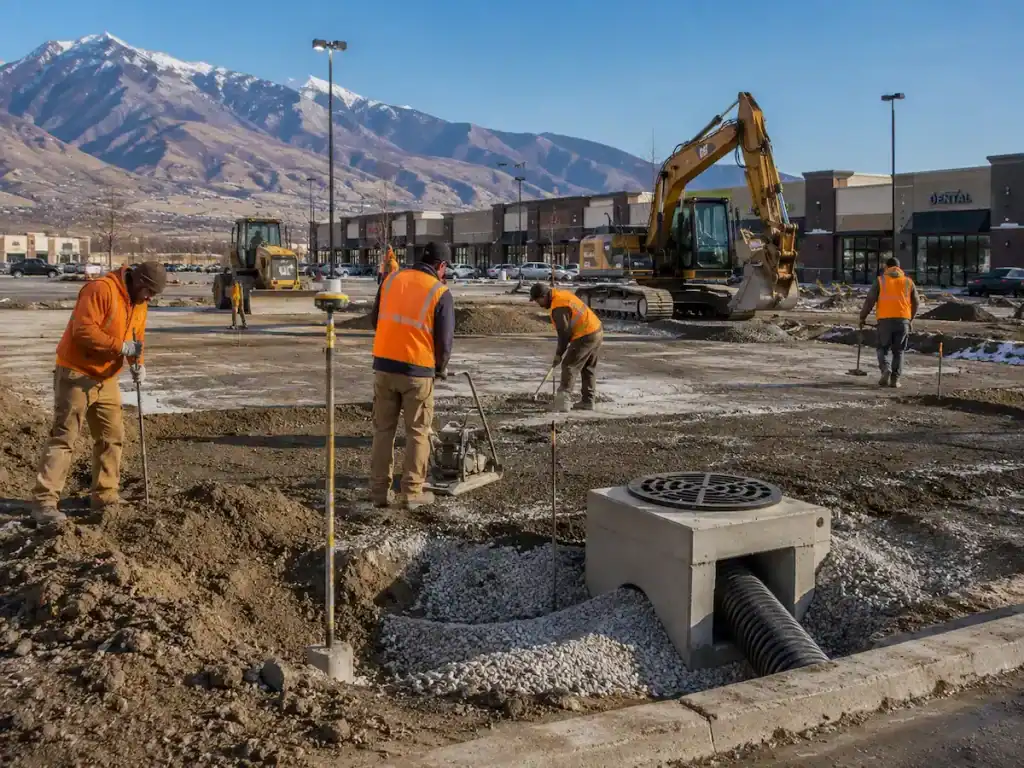
A Utah paving crew prepares the aggregate base and drainage system.
4. Aggregate Base Installation
The aggregate base provides structural support beneath the asphalt. The required base depth depends on soil conditions, expected traffic, pavement design, and project specifications.
Base material must be properly placed, graded, moisture-conditioned, and compacted. Paving over a soft, wet, or unstable base can lead to depressions, cracking, potholes, and pavement movement.
Learn more about soft spots in asphalt and how they are repaired.
5. Asphalt Placement
Hot asphalt mix is delivered to the project and placed using paving equipment. The asphalt should be installed at the appropriate temperature and thickness for the project.
Consistent material delivery and paving speed help produce a smoother surface and reduce unnecessary joints.
6. Asphalt Compaction
Compaction is one of the most important parts of asphalt installation. Rollers compact the asphalt while it remains within the proper temperature range.
Good compaction improves pavement density, strength, smoothness, water resistance, and long-term performance. Insufficient compaction can leave the asphalt more vulnerable to moisture, oxidation, movement, and early deterioration.
7. Joint and Edge Construction
Longitudinal joints, transverse joints, edges, utility transitions, drainage structures, and connections to existing pavement require careful workmanship.
Poorly constructed joints can become common entry points for water and may begin separating or cracking before the rest of the pavement.
8. Striping and Pavement Markings
After the asphalt has cooled and the property is ready, the parking lot can be striped. Striping may include:
- Parking stalls
- Accessible parking spaces
- Access aisles
- Crosswalks
- Fire lanes
- Directional arrows
- Stop bars
- Loading zones
- Numbered stalls
- Custom pavement markings
Read our guide to accessible parking lot striping requirements in Utah.
How Thick Should Commercial Asphalt Be?
There is no single asphalt thickness that is appropriate for every commercial property. Pavement design should reflect the expected traffic, underlying soils, aggregate base, drainage, and intended use.
A parking lot used mainly by passenger vehicles has different structural requirements than an industrial yard or delivery route used by heavy trucks.
Commercial paving may include multiple asphalt lifts. Installing asphalt in properly designed layers can improve compaction and structural performance.
The pavement system should be designed as a whole. A thicker asphalt surface will not fully compensate for weak soil, poor drainage, or an unstable base.
Read more about how thick asphalt pavement should be.
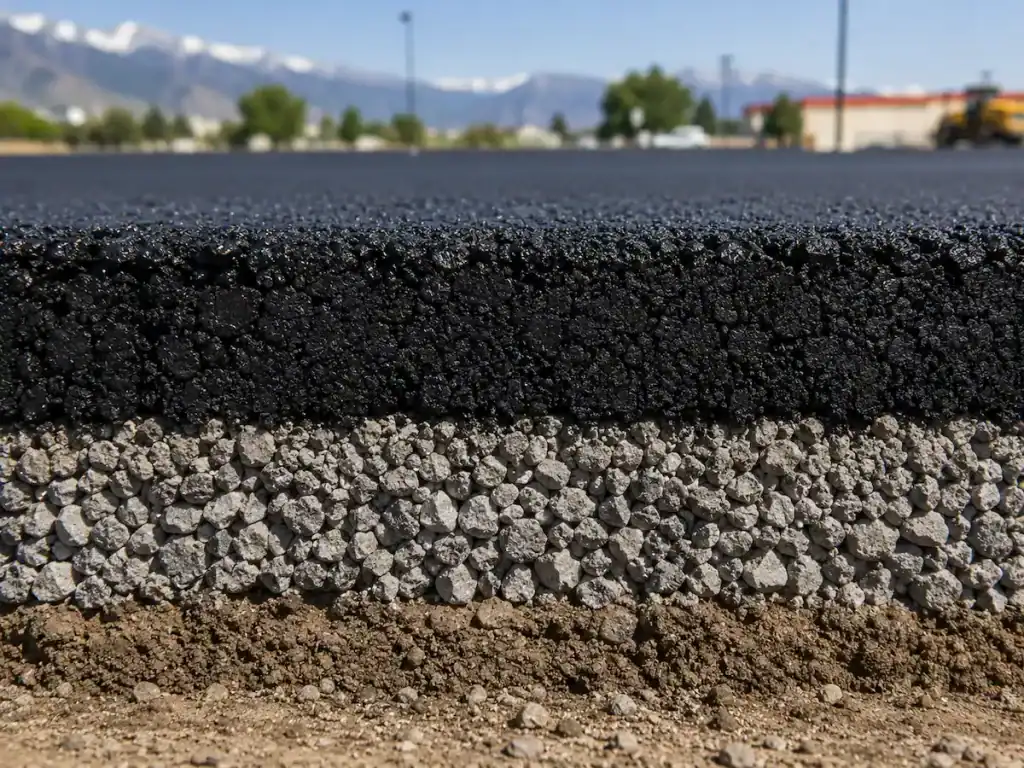
A cross-section of a properly constructed asphalt pavement.
New Construction, Overlay, or Full Replacement?
One of the most important decisions is determining which paving method is appropriate for the property.
New Asphalt Construction
New construction begins with an unpaved or newly developed site. It typically includes excavation, grading, drainage preparation, aggregate base installation, and asphalt paving.
Asphalt Overlay
An asphalt overlay places a new asphalt layer over an existing paved surface. Overlays can be effective when the underlying pavement and base remain structurally stable.
Before an overlay, the contractor may need to repair failed sections, mill transitions, adjust utilities, correct drainage, and seal or address existing cracks.
Full-Depth Replacement
Full replacement involves removing the existing asphalt and rebuilding damaged or unstable sections. This option may be necessary when the pavement has widespread structural failure, severe alligator cracking, base movement, major drainage problems, or repeated patch failures.
Learn more about asphalt overlays versus full replacement in Utah.
How Much Does Commercial Asphalt Paving Cost in Utah?
Commercial asphalt paving costs vary significantly from one property to another. Contractors generally need to evaluate the site before providing an accurate estimate.
Major cost factors include:
- Total square footage
- Asphalt thickness
- Aggregate base requirements
- Existing pavement removal
- Milling requirements
- Grading and excavation
- Drainage improvements
- Soil and subgrade conditions
- Utility adjustments
- Concrete curbs and sidewalks
- Site accessibility
- Traffic control
- Project phasing
- Distance from asphalt plants
- Material and fuel pricing
- Parking lot striping
Large, open projects may have a lower cost per square foot than small or highly complex projects because crews and equipment can operate more efficiently.
Properties with severe drainage issues, soft subgrade, restricted access, or extensive demolition generally cost more than straightforward resurfacing projects.
See our 2026 Utah asphalt paving cost guide for additional pricing information.
How Long Does Commercial Asphalt Last in Utah?
Properly installed and maintained commercial asphalt can often last 15 to 25 years or longer. Actual pavement life varies according to construction quality, traffic, climate, drainage, maintenance, and usage.
A lightly used office parking lot may age differently than a busy retail center, trucking facility, school bus lane, or industrial loading area.
Factors that can shorten pavement life include:
- Poor drainage
- Inadequate base preparation
- Insufficient asphalt thickness
- Heavy vehicle traffic
- Utility trench settlement
- Unsealed cracks
- Standing water
- Repeated snowplow damage
- Delayed repairs
- Oil and chemical exposure
Read our complete guide explaining how long asphalt lasts in Utah.
Commercial Asphalt Maintenance After Paving
New pavement should be protected with a long-term maintenance plan. Preventative maintenance is usually less disruptive and less expensive than waiting until widespread structural damage develops.
Routine Pavement Inspections
Commercial properties should be inspected regularly for cracking, standing water, surface deterioration, damaged drains, faded striping, potholes, and movement around utility covers.
Crack Sealing
Crack sealing helps reduce the amount of water entering the pavement structure. Cracks should generally be addressed before they widen or develop into connected areas of structural cracking.
Learn more about commercial asphalt crack sealing in Utah.
Sealcoating
Sealcoating can help protect suitable asphalt surfaces from oxidation, UV exposure, moisture, and surface wear. It also restores a darker, more uniform appearance.
Sealcoating is not a structural repair and should not be used to hide failed pavement. Cracks, potholes, and damaged areas should be repaired before the sealcoat is applied.
Learn more about commercial asphalt sealcoating.
Asphalt Patching
Localized failures may be repaired by removing damaged pavement, correcting the underlying problem, and installing new asphalt.
Professional patching can prevent damaged areas from expanding and becoming larger safety concerns.
Explore asphalt patching and pothole repair services.
Parking Lot Restriping
Striping should be repainted when stalls, crosswalks, traffic markings, and accessible symbols are no longer clearly visible.
Clear striping improves traffic flow, appearance, parking efficiency, and pedestrian safety.
Read about when Utah parking lots should be restriped.
How to Plan a Commercial Paving Project
Commercial paving can affect employees, customers, tenants, deliveries, emergency access, and daily business operations. Planning ahead can significantly reduce disruption.
Before construction begins, property owners and managers should consider:
- Which entrances must remain open
- Where employees and customers will park
- How deliveries will reach the property
- Whether work should be phased
- How tenants or residents will be notified
- Whether nighttime or weekend work is appropriate
- When garbage collection occurs
- Where snow-removal equipment is stored
- Whether irrigation must be turned off
- Whether utility work should be completed first
- How pedestrians will safely move around the work area
A professional paving contractor should communicate the project schedule, closure areas, access plan, curing time, and reopening expectations before work begins.

A paving crew applies a fresh sealcoat to a commercial parking lot.
When Is the Best Time for Commercial Asphalt Paving in Utah?
Commercial asphalt paving is generally completed during warmer months when weather and pavement temperatures allow the asphalt to be placed and compacted properly.
Spring, summer, and early fall are common paving seasons in Utah. However, exact scheduling depends on elevation, regional weather, project size, asphalt availability, and nighttime temperatures.
High-elevation projects may have a shorter paving season than projects in lower valleys. Larger commercial projects should be planned early because paving schedules can fill quickly during peak construction months.
Read our guide to the best time of year for asphalt paving in Utah.
How to Choose a Commercial Asphalt Paving Contractor
The paving contractor you select can have a major effect on pavement quality, project communication, scheduling, and long-term performance.
Before hiring a contractor, consider asking:
- How long has the company completed asphalt work in Utah?
- Does the company regularly handle projects of this size?
- Is the contractor licensed and insured?
- Who will manage the project?
- How will drainage be evaluated?
- What base preparation is included?
- What asphalt thickness is proposed?
- How will traffic and property access be managed?
- Will damaged areas be repaired before an overlay?
- What is included in the written estimate?
- Does the company have verified customer reviews?
- Can the contractor provide examples of similar work?
Property owners should be cautious of unusually low bids, vague proposals, high-pressure sales tactics, cash-only offers, and contractors who arrive unexpectedly with leftover asphalt.
Read our guide explaining how to choose the best asphalt paving contractor in Utah.
Why Choose Eckles Paving?
Eckles Paving has provided professional asphalt paving and pavement maintenance services throughout Utah for more than 35 years.
Our team works with business owners, property managers, HOAs, developers, general contractors, schools, churches, industrial facilities, and municipalities.
Commercial property owners choose Eckles Paving for:
- More than 35 years of Utah paving experience
- Experienced asphalt paving crews
- Commercial and large-project capabilities
- Professional equipment
- Detailed site preparation
- Grading and drainage expertise
- Clear project communication
- Dependable scheduling
- Complete pavement maintenance services
- More than 1,300 five-star reviews
- A 5.0 Google rating
- Licensed and insured service
Our team provides a complete range of Utah asphalt services, including paving, milling, grading, drainage, crack sealing, sealcoating, patching, repair, and parking lot striping.
Commercial Asphalt Paving Areas We Serve
Eckles Paving completes commercial asphalt projects throughout Utah, including Utah County, Salt Lake County, Davis County, Weber County, Cache County, Summit County, Wasatch County, Tooele County, Morgan County, Box Elder County, and surrounding areas.
Our primary service areas include:
- Salt Lake City
- West Valley City
- West Jordan
- South Jordan
- Sandy
- Draper
- Provo
- Orem
- Lehi
- American Fork
- Springville
- Spanish Fork
- Ogden
- Layton
- Logan
- Park City
- Heber City
- Tooele
- Brigham City
View the complete list of Utah asphalt paving service areas.
Frequently Asked Questions About Commercial Asphalt Paving
How much does a commercial asphalt parking lot cost in Utah?
The cost depends on square footage, asphalt thickness, base preparation, demolition, drainage, grading, accessibility, traffic control, and striping. A site evaluation is normally required before an accurate commercial paving estimate can be provided.
How long does it take to pave a commercial parking lot?
Smaller commercial lots may be completed within a few days, while large or complex projects may take longer. Demolition, grading, drainage work, base repairs, project phasing, weather, and curing requirements can all affect the schedule.
Can a business remain open during asphalt paving?
Many businesses can remain partially open when the project is completed in phases. The contractor and property manager should create a traffic and access plan before construction begins.
How soon can vehicles drive on new commercial asphalt?
Reopening time depends on weather, pavement temperature, asphalt thickness, traffic type, and project conditions. The paving contractor should provide specific instructions before vehicles are allowed onto the new surface.
Should a damaged parking lot be repaired or completely replaced?
Localized damage may be suitable for patching or an overlay. Widespread structural cracking, unstable base material, repeated failures, and major drainage problems may require full-depth replacement.
Can new asphalt be installed over an existing parking lot?
Yes, an asphalt overlay may be possible when the existing pavement and base remain structurally stable. Failed areas, drainage problems, cracks, and elevation transitions should be evaluated before paving.
How often should a commercial parking lot be sealcoated?
Many Utah parking lots are sealcoated every two to four years, depending on traffic, pavement condition, weather exposure, and the type of sealcoat used. New asphalt should be allowed to cure before its first sealcoat application.
Why is drainage important for a commercial parking lot?
Standing water can enter cracks, weaken the pavement base, create ice, damage asphalt, and contribute to potholes. Proper grading and drainage help protect the entire pavement structure.
Does new asphalt automatically include parking lot striping?
Striping may be included as part of a complete paving proposal, but property owners should confirm the number of stalls, accessible spaces, crosswalks, arrows, fire lanes, and custom markings included in the estimate.
What is the best asphalt maintenance plan for a commercial property?
A strong plan includes routine inspections, timely crack sealing, localized repairs, periodic sealcoating, drainage maintenance, and restriping when markings become faded.
Request a Commercial Asphalt Paving Estimate
Whether you are planning a new parking lot, private road, industrial yard, HOA paving project, asphalt overlay, or complete pavement replacement, proper construction is essential for long-term performance.
Eckles Paving provides commercial asphalt paving in Utah using professional equipment, experienced crews, quality materials, and paving methods designed for Utah’s demanding climate.
Contact Eckles Paving today to request a free commercial asphalt paving estimate.