If you have researched affordable alternatives to traditional paving, you may have come across asphalt millings. They are commonly used for driveways, private roads, parking areas, shoulders, and other surfaces, but they are not the right choice for every project.
So, what are asphalt millings, and should you use them? Asphalt millings are recycled pieces of pavement produced when an existing surface is removed with a milling machine. The material can then be reused instead of immediately becoming waste.
For certain applications, properly placed and compacted asphalt millings can provide a practical surface. However, they are different from newly installed hot-mix asphalt and should not automatically be treated as a direct replacement.
Eckles Paving provides professional asphalt milling, asphalt paving, grading, and pavement repair throughout Utah.
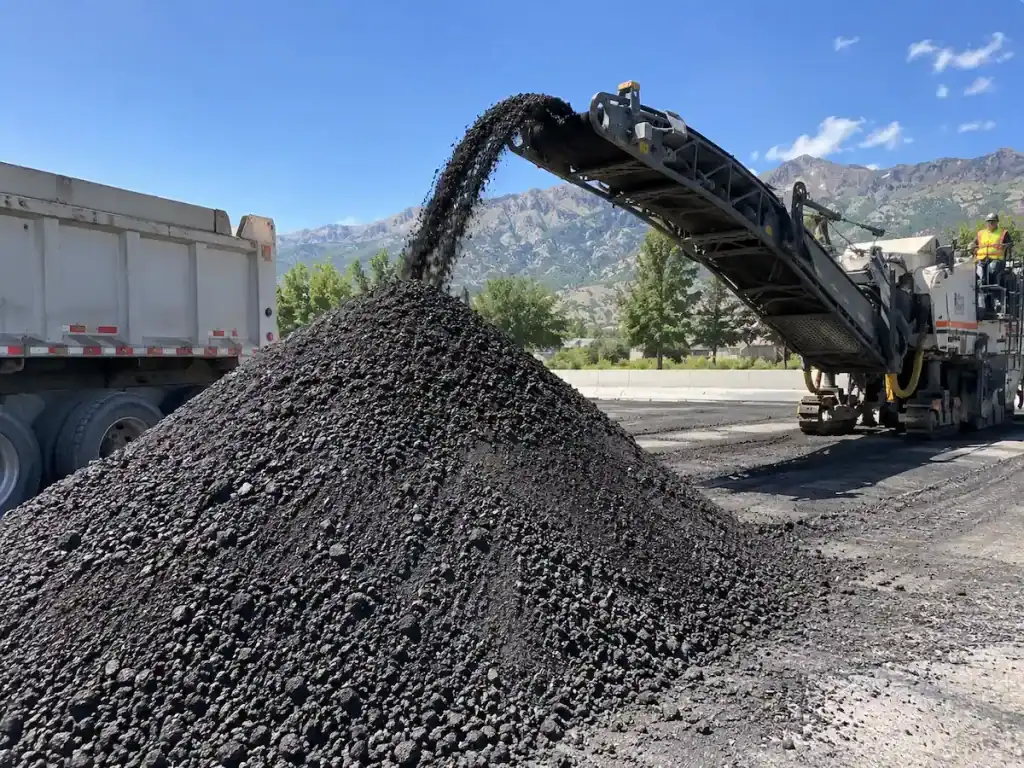
Eckles Paving crew working on the milling process.
What Are Asphalt Millings?
Asphalt millings are recycled asphalt material created when a milling machine removes part or all of an existing asphalt surface.
During milling, a rotating drum removes pavement at a controlled depth. The removed asphalt is broken into smaller pieces and collected so it can be transported away from the project.
Instead of treating that material simply as waste, asphalt millings can sometimes be reused for other applications.
You may also hear asphalt millings referred to as recycled asphalt pavement or RAP, although the terminology and material specifications can vary depending on how the recycled asphalt will be processed and used.
Where Do Asphalt Millings Come From?
Millings typically come from existing roads, parking lots, and other asphalt surfaces that are being rehabilitated or resurfaced.
For example, a commercial parking lot may have several inches of existing asphalt removed before crews install a new overlay. The milling process creates recycled asphalt material while also preparing the property for new pavement.
Eckles Paving recently used this process during our Deer Valley Resort asphalt paving project in Park City, where three inches of existing asphalt were milled and hauled before a new three-inch overlay was installed across approximately 33,000 square feet.
What Do Asphalt Millings Look Like?
Asphalt millings generally look like a mixture of dark gray or black crushed pavement particles. The size and consistency can vary depending on the original pavement, milling process, processing, and material source.
Unlike fresh hot-mix asphalt, millings arrive as loose recycled material. They need to be properly placed, graded, and compacted when they are being used to create a driving surface.
What Are Asphalt Millings Used For?
Asphalt millings can be considered for several types of projects, including:
- Residential driveways
- Private roads
- Rural access roads
- Parking areas
- Equipment or storage areas
- Road shoulders
- Temporary access areas
- Other lower-demand driving surfaces
Whether millings make sense depends on how the area will be used and what the property owner expects from the finished surface.
Can You Use Asphalt Millings for a Driveway?
Yes, asphalt millings can be used for some driveways. They may be particularly appealing when a property owner wants something more substantial than a loose gravel surface without installing a conventional hot-mix asphalt driveway.
However, a millings driveway and a professionally paved driveway are not the same product.
Fresh asphalt is produced as a designed paving mixture, placed while hot, and compacted into a continuous pavement layer. Millings are previously used asphalt that has been removed and recycled.
If you are considering a new driveway, it is worth comparing the expected use, appearance, maintenance, budget, drainage, and desired lifespan before choosing the surface.
You can learn more about conventional asphalt installation in our guide to asphalt driveway installation in Utah.
Are Asphalt Millings Better Than Gravel?
Asphalt millings and gravel each have advantages, so one is not automatically better for every property.
Properly installed millings can create a more bound and pavement-like driving surface than loose gravel under suitable conditions. They may also reduce some of the movement associated with an untreated gravel surface.
Gravel, however, is widely available and can be appropriate for many rural roads, driveways, and lower-cost access areas.
The quality of the base and installation can matter just as much as the surface material. A poorly prepared driveway will not become a high-quality pavement simply because asphalt millings are placed over it.
Are Asphalt Millings the Same as New Asphalt?
No. This is one of the most important distinctions for property owners to understand.
Asphalt millings contain recycled asphalt material, but spreading and compacting does not recreate the same pavement structure as installing a new hot-mix asphalt surface.
A professionally paved asphalt project typically involves evaluating the subgrade and base, establishing grades and drainage, placing the appropriate asphalt mixture at a specified thickness, and compacting the material while it is hot.
The required pavement thickness can also change based on expected traffic. Our article explaining how an asphalt company determines asphalt thickness covers some of the factors involved.
What Are the Benefits of Asphalt Millings?
Asphalt millings can offer several potential benefits when they are appropriate for the project.
Recycled Material
Millings reuse material removed from existing pavement. Recycling asphalt allows valuable pavement material to remain useful rather than treating all removed asphalt as waste.
Potentially Lower-Cost Surface
Depending on material availability, hauling, preparation, installation, and local conditions, millings may provide a lower-cost alternative to installing new asphalt.
Useful for Certain Low-Demand Areas
Private roads, rural access areas, storage areas, and some residential driveways may not require the same finished surface expected from a commercial parking lot or heavily traveled roadway.
Can Create a More Finished Surface Than Loose Material
When properly graded and compacted, asphalt millings can form a relatively firm driving surface.
What Are the Disadvantages of Asphalt Millings?
The lower cost or recycled nature of millings should not distract from their limitations.
The Finished Surface Can Vary
Millings are recycled material, so consistency can vary. Material source, particle size, contamination, age, and processing can affect the finished result.
They Do Not Perform Exactly Like New Asphalt
Compacted millings should not be expected to automatically provide the same smoothness, appearance, structural characteristics, or performance as professionally installed hot-mix asphalt.
Installation Still Matters
Simply dumping millings onto the ground is not the same as constructing a properly prepared driving surface. Grading, drainage, base conditions, placement, and compaction remain important.
They May Not Match the Appearance You Want
If appearance is a major priority, such as at a commercial entrance or finished residential property, fresh asphalt may provide the more uniform finished surface the property owner expects.
Do Asphalt Millings Need a Good Base?
Yes. The material underneath the driving surface remains important.
If the subgrade is soft, unstable, poorly drained, or improperly graded, placing millings over the top does not eliminate those underlying problems.
A stable aggregate base helps support vehicle loads and provides a foundation for the surface above it. Proper grading also helps establish appropriate slopes so water moves away from the pavement instead of collecting in low areas.
Base problems are one reason some asphalt surfaces develop soft spots and recurring failures. Correcting the underlying cause is generally more effective than repeatedly covering the problem.
Do Asphalt Millings Need to Be Compacted?
Yes. If they are being used as a finished driving surface, proper compaction is an important part of installation.
Compaction helps consolidate the loose material and create a firmer, more stable surface. The equipment and process should be appropriate for the size and intended use of the project.
Without adequate grading and compaction, the material may remain loose, develop uneven areas, or move under traffic.
Can Asphalt Millings Handle Utah Weather?
Utah creates demanding conditions for nearly every outdoor pavement surface. Summer heat and UV exposure are followed by cold winters, snow, ice, moisture, and repeated freeze-thaw cycles.
The ability of a millings surface to perform through these conditions depends heavily on drainage, base stability, compaction, traffic, and the quality of the recycled material.
Water is especially important. When water collects on or beneath a driving surface, it can contribute to soft areas, movement, and deterioration during freezing and thawing.
Learn more about these conditions in our guide to how Utah weather damages asphalt.
Are Asphalt Millings Good for Heavy Trucks?
A surface that regularly handles heavy trucks requires more consideration than a lightly used residential driveway.
Heavy vehicles place greater loads on the pavement structure. Base thickness, asphalt thickness, drainage, subgrade conditions, turning movements, and traffic frequency can all affect pavement design.
For commercial or industrial areas with regular truck traffic, millings alone may not provide the pavement structure the property requires.
Our guide to asphalt paving for heavy truck traffic explains why these areas need additional planning.
Can You Sealcoat Asphalt Millings?
Sealcoating is designed primarily as a preventive maintenance treatment for suitable asphalt pavement. A loose or irregular surface does not behave exactly like a conventional asphalt pavement surface.
Before applying any coating or treatment to millings, the condition and construction of the surface should be evaluated and the product manufacturer’s requirements should be considered.
For conventional asphalt pavement, our guide to how many coats of sealcoat you need explains how sealcoating is typically approached.
Can You Put New Asphalt Over Asphalt Millings?
Whether an existing millings surface can become part of the foundation for new asphalt depends on its condition, thickness, stability, drainage, grading, and the requirements of the new pavement.
A paving contractor should inspect the site before deciding whether existing material can remain or needs additional preparation.
Installing new asphalt over an unstable surface can allow underlying problems to affect the new pavement.
Asphalt Millings vs. Asphalt Overlay
These terms are sometimes confused, but they describe very different things.
Asphalt millings are recycled material removed from existing pavement. They may be reused as a surface or incorporated into other asphalt applications.
An asphalt overlay is a new layer of asphalt installed over a prepared existing pavement surface.
On some rehabilitation projects, both processes occur. Crews may mill existing asphalt to a specified depth and then install a new asphalt overlay.
That was the approach used on Eckles Paving’s Deer Valley Resort project in Park City, where three inches of existing pavement were milled before a new three-inch asphalt overlay was installed.
Asphalt Millings vs. Asphalt Replacement
Full asphalt replacement is generally considered when the existing pavement or underlying structure has deteriorated enough that simply improving the surface will not adequately address the problem.
Replacement may involve removing existing asphalt, correcting unsuitable base or subgrade conditions, establishing proper grades, and installing new pavement.
Millings can be useful recycled material, but placing them over failed pavement does not automatically correct structural problems underneath.
If an existing asphalt surface is deteriorating, our guide to deciding whether to sealcoat, resurface, or replace asphalt can help explain the differences between common treatment options.
Should You Use Asphalt Millings?
Asphalt millings can make sense when the project calls for an economical recycled driving surface and the property owner understands that the result will differ from newly paved asphalt.
They may be worth considering for certain private roads, rural driveways, access areas, shoulders, or lower-demand surfaces.
New hot-mix asphalt may make more sense when the project requires a smoother finished surface, predictable pavement structure, frequent traffic, commercial use, or a more finished appearance.
The decision should consider:
- How the surface will be used
- Vehicle types and traffic levels
- Existing soil and base conditions
- Drainage
- Desired appearance
- Available budget
- Long-term maintenance expectations
- Material availability and quality
A site evaluation can help determine whether millings, new asphalt, or another approach better fits the property.
Frequently Asked Questions About Asphalt Millings
What are asphalt millings?
Asphalt millings are recycled pieces of pavement created when a milling machine removes material from an existing asphalt surface.
Are asphalt millings good for driveways?
They can be suitable for some driveways, particularly when the property owner wants an alternative to gravel or new asphalt. Proper base preparation, grading, and compaction are still important.
Are asphalt millings cheaper than asphalt?
Millings may cost less than a new hot-mix asphalt surface in some situations, but pricing depends on material availability, hauling distance, site preparation, project size, and installation requirements.
Do asphalt millings get hard?
Properly placed and compacted millings can create a firm driving surface, but they should not be assumed to become identical to newly installed hot-mix asphalt.
Do asphalt millings need to be compacted?
Yes. Proper compaction helps consolidate the material and create a more stable, uniform surface.
Are asphalt millings the same as recycled asphalt?
Asphalt millings are a form of recycled asphalt pavement produced by removing existing pavement with a milling machine. Recycled asphalt can also be processed and reused in other asphalt applications.
How thick should asphalt millings be?
There is not one appropriate thickness for every project. The required depth depends on the intended use, vehicle loads, base conditions, material characteristics, and installation method.
Can asphalt millings fix a bad driveway base?
No. If the underlying soil or base is unstable, poorly drained, or improperly graded, those conditions should be addressed rather than simply covered with millings.
Why Choose Eckles Paving?
Eckles Paving has more than 35 years of experience with asphalt paving, milling, grading, repair, and pavement maintenance throughout Utah.
Our crews work on commercial parking lots, private roads, driveways, HOAs, apartment communities, schools, industrial properties, municipal projects, and other paved surfaces.
Because we provide asphalt milling, grading, paving, and repair, we can evaluate more than just the top surface when planning a project.
Learn more about Eckles Paving and our asphalt services throughout Utah.
Paving Throughout Utah
Eckles Paving provides asphalt services throughout Utah County, Salt Lake County, Summit County, Wasatch County, Davis County, Weber County, Cache County, Tooele County, and communities throughout Utah.
Visit our Utah asphalt service areas page to learn more about the areas we serve.
Get a Free Asphalt Estimate
If you are deciding between asphalt millings, new paving, resurfacing, or another option, Eckles Paving can evaluate your property and help you understand the appropriate approach for the site.
Contact Eckles Paving for a free asphalt estimate in Utah.
Industry Resources
- Asphalt Institute — Technical and educational information about asphalt pavement materials, construction, and maintenance.
- Federal Highway Administration Pavement Recycling — Information about pavement recycling and the reuse of asphalt pavement materials.