When you hire a Utah asphalt paving contractor, the equipment they bring to the job can tell you a lot about their ability to complete the project efficiently and produce a durable finished surface. Professional Utah asphalt paving requires far more than a paving machine and a roller. Contractors need the right combination of grading, paving, compaction, hauling, milling, and support equipment for the size and conditions of each project.
This becomes especially important in Utah, where contractors must account for changing elevations, freeze-thaw cycles, drainage conditions, heavy commercial traffic, and seasonal temperature swings. The right equipment helps crews prepare a stable base, place asphalt consistently, achieve proper compaction, and complete large projects without unnecessary delays.
If you are planning a parking lot, private road, commercial development, or pavement replacement project, learn more about Eckles Paving’s Utah asphalt paving services or request a free estimate.
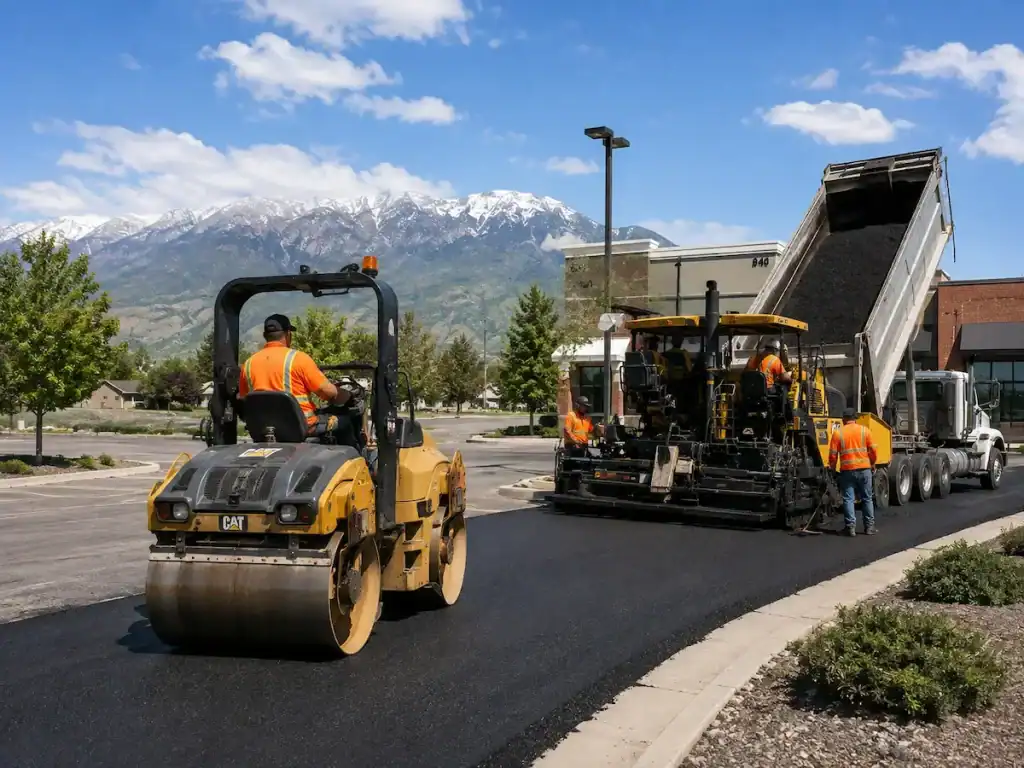
Professional paving equipment installing and compacting fresh asphalt.
Why Asphalt Paving Equipment Matters
Utah Asphalt performance begins long before the final surface becomes visible. Contractors must properly prepare the existing ground, establish grades, compact the base, transport asphalt to the project, place the material at the correct thickness, and compact it before it cools.
Using equipment that is too small, poorly maintained, or inappropriate for the project can make those steps more difficult. Large commercial parking lots, industrial facilities, subdivision roads, and municipal projects often require significantly more equipment and coordination than a small residential driveway.
A professional Utah asphalt paving contractor should select equipment based on the project rather than trying to make one setup work for every job.
Asphalt Pavers
The asphalt paver is one of the most recognizable machines on a paving project. It receives hot asphalt mix and distributes it across the prepared surface at a controlled width and thickness.
Professional paving machines use a screed behind the paver to help establish a smooth, consistent asphalt mat before rollers begin compaction.
The appropriate paver depends on the project. Smaller machines can be useful in tight areas, while larger commercial pavers can place asphalt more efficiently across wide parking lots, roads, and industrial sites.
For large projects, continuous paving is important. Frequent stopping and starting can make it more difficult to maintain a consistent surface. Contractors therefore need to coordinate the paving machine with asphalt deliveries, crew members, rollers, and jobsite access.
Asphalt Rollers and Compaction Equipment
Placing asphalt is only part of the process. Crews must also compact the material correctly while it remains within the proper temperature range.
Different projects may use several types of rollers, including vibratory steel-drum rollers and finish rollers. Contractors select the equipment according to asphalt thickness, mix design, project size, and site conditions.
Proper compaction helps reduce air voids and creates a dense pavement structure that can better withstand traffic and weather.
Utah’s freeze-thaw cycles make compaction especially important. Water entering poorly compacted pavement can contribute to cracking and deterioration as temperatures repeatedly move above and below freezing.
Once pavement begins developing cracks or surface failures, timely asphalt repair services can help prevent localized problems from spreading.
Graders and Base Preparation Equipment
A smooth asphalt surface depends heavily on what lies underneath it. Before paving begins, contractors may need to excavate unsuitable material, establish elevations, shape the site, and prepare the aggregate base.
Motor graders, skid steers, loaders, excavators, and compactors can all play roles in preparing a paving site.
Professional grading services help establish the proper slope and elevation before asphalt installation. This is particularly important for commercial properties where water must move toward drains, gutters, detention areas, or other designated drainage locations.
A paving contractor that understands grading can address underlying site conditions instead of simply paving over them.
Skid Steers and Compact Track Loaders
Skid steers and compact track loaders are some of the most versatile machines on an asphalt project. Crews may use them to move aggregate, remove damaged pavement, clean work areas, handle attachments, prepare edges, and complete work in areas that larger equipment cannot easily reach.
Attachments can also allow these machines to perform specialized tasks such as sweeping, milling small areas, excavating, or grading.
Although they are smaller than many pieces of paving equipment, skid steers often play an important support role in keeping a project moving efficiently.
Asphalt Milling Machines
Not every paving project requires complete excavation and replacement. Sometimes contractors can remove a specific depth of existing asphalt through milling.
An asphalt milling machine grinds away deteriorated pavement while allowing crews to control the removal depth. Milling can help correct surface problems, prepare pavement for an overlay, improve transitions, or remove damaged material around curbs and structures.
Professional asphalt milling is especially useful on commercial parking lots and roadway projects where maintaining proper elevations is important.
For example, simply adding asphalt over an existing parking lot can raise the pavement around gutters, entrances, drains, or concrete. Milling allows contractors to remove material where necessary before installing the new surface.
Dump Trucks and Asphalt Hauling
Hot-mix asphalt must reach the jobsite while it remains workable enough for proper placement and compaction. That makes trucking and delivery coordination an important part of a paving project.
Dump trucks transport asphalt from the production plant to the paving crew. On larger projects, contractors may coordinate a continuous sequence of trucks so the paving machine receives material without lengthy interruptions.
Experienced contractors plan truck timing around travel distance, plant production, traffic, paving speed, weather, and the amount of asphalt required.
This logistical planning becomes particularly important on large Utah commercial projects where hundreds or thousands of tons of asphalt may need to move through the jobsite efficiently.
Plate Compactors and Trench Compaction Equipment
Large rollers cannot reach every area of a paving project. Around utilities, edges, trenches, curbs, structures, and confined spaces, crews may need smaller compaction equipment.
Plate compactors and similar machines help crews compact aggregate base or asphalt in locations that larger rollers cannot safely or effectively access.
Properly compacting these smaller areas matters because weak edges or poorly compacted utility trenches can eventually settle and create pavement failures.
Sweepers and Surface Preparation Equipment
Pavement must be clean before certain asphalt applications. Dust, loose aggregate, vegetation, and debris can interfere with bonding between pavement layers or maintenance materials.
Mechanical sweepers, blowers, and other cleaning equipment help prepare the surface before paving, crack sealing, sealcoating, or striping.
Surface preparation may appear simple, but skipping it can reduce the effectiveness of later pavement work.
Tack Coat Application Equipment
When Utah asphalt paving contractors install new asphalt over an existing asphalt surface, they commonly apply a tack coat between layers. Tack material helps the new asphalt bond to the existing pavement.
Utah asphalt paving contractors need equipment capable of applying tack consistently across the required surface. Even coverage helps the asphalt layers perform together rather than behaving like separate surfaces.
The exact paving method depends on the condition of the existing pavement, which is why contractors should evaluate whether a property needs an overlay, milling, localized repairs, or full reconstruction before recommending a solution.
Equipment for Asphalt Repair and Patching
Commercial paving contractors should also have equipment for repairing isolated pavement failures. Depending on the repair, crews may use saws, milling attachments, excavators, skid steers, compactors, rollers, and paving equipment.
Proper asphalt patching and pothole repair typically involves removing failed material and addressing the underlying cause rather than simply placing asphalt over a damaged area.
If water, unstable base material, or drainage problems caused the failure, those conditions should be considered during the repair.
Drainage Equipment and Site Preparation
Water is one of the biggest long-term threats to pavement. Standing water can penetrate cracks, weaken pavement foundations, and contribute to freeze-thaw damage during Utah winters.
Depending on the site, a paving contractor may need excavators, grading equipment, trenching equipment, compactors, or concrete equipment to improve drainage before paving begins.
Eckles Paving provides parking lot drainage solutions for properties where drainage conditions need to be addressed as part of a pavement project.
Correcting drainage during construction is often more effective than repeatedly repairing pavement damaged by the same underlying water problem.
Parking Lot Striping Equipment
For commercial parking lots, paving often represents only one stage of the finished project. After new asphalt has been installed and the appropriate curing or project requirements have been met, crews may complete pavement markings.
Professional striping machines help produce consistent lines for parking stalls, traffic markings, directional arrows, fire lanes, loading zones, and accessible parking areas.
Property owners can learn more about parking lot striping in Utah when planning a complete parking lot improvement project.
Does Every Asphalt Contractor Need the Same Equipment?
No. The appropriate equipment depends on the type and scale of work a contractor performs.
A contractor focused mainly on small residential repairs may not need the same equipment, trucking capacity, or crew size as a company paving large commercial parking lots, private roads, industrial facilities, schools, or municipal properties.
When evaluating a contractor, property owners should consider whether the company regularly performs projects similar in size and complexity to their own.
Equipment alone does not guarantee a good paving job. Experienced operators, knowledgeable supervisors, proper preparation, appropriate materials, and careful project planning are just as important.
What Equipment Matters Most for Large Commercial Paving Projects?
Large commercial projects require coordination between several types of equipment rather than relying on a single machine.
A typical project may involve:
- Excavators or loaders for removal and site preparation
- Graders or skid steers for establishing elevations
- Base compaction equipment
- Asphalt milling equipment when existing pavement must be removed
- Dump trucks for material delivery
- A commercial asphalt paver
- Multiple rollers for proper compaction
- Mechanical sweepers and surface preparation equipment
- Striping equipment for completed parking lots
Having the right equipment available helps contractors sequence the project efficiently and respond to changing site conditions.
Utah Conditions Make Proper Equipment Especially Important
Utah paving projects can present very different conditions depending on location. A commercial property along the Wasatch Front may face heavy traffic and winter snow removal, while projects in Park City, Heber, or other mountain communities may experience higher elevations, colder temperatures, and more frequent freeze-thaw cycles.
Southern and lower-elevation areas can experience significant heat and UV exposure, while many developing areas have soil and drainage conditions that require careful base preparation.
Professional paving contractors must adjust equipment, materials, schedules, and construction methods to the actual conditions of each site.
Preparing the base correctly, establishing drainage, achieving proper compaction, and selecting an appropriate pavement structure can have a much larger effect on long-term performance than simply making the finished asphalt look smooth.
Questions to Ask a Utah Asphalt Paving Contractor About Equipment
You do not need to know every machine used in asphalt construction before hiring a contractor. However, a few practical questions can help determine whether a company is prepared for your project.
- Do you regularly complete projects similar in size to ours?
- How will you prepare and compact the aggregate base?
- What paving and rolling equipment will you use?
- Will milling be required before paving?
- How will you manage drainage and pavement elevations?
- How will asphalt deliveries be coordinated during paving?
- What equipment will you use in tight areas and around structures?
- Who will operate and supervise the paving equipment?
A qualified contractor should be able to explain the process in straightforward terms and describe why certain equipment is appropriate for your property.
Equipment Is Only One Part of Choosing a Paving Contractor
Modern equipment can improve production and consistency, but equipment should not be the only factor you consider.
Contractor experience, site preparation, crew knowledge, drainage planning, communication, materials, scheduling, and quality control all influence the finished pavement.
When comparing contractors, review the complete proposed scope rather than choosing a company simply because it owns a particular machine or submits the lowest bid.
You can also review Eckles Paving’s complete Utah asphalt services to see how paving, repair, grading, milling, drainage, sealcoating, crack sealing, and striping work together throughout the life of a pavement system.
Why Choose Eckles Paving?
Eckles Paving has more than 35 years of experience completing asphalt paving and pavement maintenance projects throughout Utah. Our crews work on commercial parking lots, private roads, HOA communities, industrial properties, schools, churches, retail developments, municipal projects, and residential properties when appropriate.
Our capabilities include asphalt paving, asphalt repair, grading, milling, drainage improvements, crack sealing, sealcoating, and parking lot striping. That broad range of services allows our crews to address both the visible pavement surface and many of the underlying conditions that affect long-term performance.
Eckles Paving is licensed and insured and has the equipment, experienced crews, and project capabilities needed for both routine pavement work and larger commercial paving projects. The company has also earned more than 1,300 five-star reviews and maintains a 5.0 Google rating.
Learn more about Eckles Paving and our experience serving Utah property owners and contractors.
Utah Areas We Serve
Eckles Paving provides asphalt paving and pavement maintenance throughout much of Utah, including Utah County, Salt Lake County, Davis County, Weber County, Cache County, Summit County, Wasatch County, Tooele County, Morgan County, and Box Elder County.
Our service areas include communities throughout the Wasatch Front as well as Salt Lake City, West Valley City, Park City, Heber, Ogden, Logan, Mapleton, and surrounding Utah communities.
Visit our Utah asphalt service areas page to learn more about locations served by Eckles Paving.
Frequently Asked Questions
What equipment does an asphalt paving contractor need?
A professional asphalt paving contractor may use pavers, rollers, graders, loaders, skid steers, milling machines, excavators, dump trucks, compactors, sweepers, and other support equipment. The exact equipment should match the size and conditions of the project.
Why are rollers important when paving asphalt?
Rollers compact newly placed asphalt while it is still hot enough to achieve the required density. Proper compaction helps create a strong, stable pavement surface and reduces excessive air voids that can allow water into the pavement.
Does a paving contractor need a milling machine?
Not every project requires milling, but milling equipment can be valuable when contractors need to remove deteriorated asphalt. It can also be helpful when contractors need to prepare a surface for an overlay, or maintain proper elevations around curbs, drains, and transitions.
Should an asphalt contractor also have grading equipment?
A contractor performing complete pavement construction should have access to appropriate grading and base preparation equipment. Proper elevations, drainage, and base compaction are essential parts of building pavement that performs well over time.
Does better equipment automatically mean better asphalt?
No. Quality equipment is important, but experienced operators, good project planning, proper materials, correct base preparation, drainage, and compaction are equally important. Property owners should evaluate the contractor’s overall capabilities rather than equipment alone.
What should I look for when hiring a Utah asphalt paving contractor?
Look for relevant Utah experience, licensing and insurance, commercial project capabilities, knowledgeable crews, appropriate equipment, clear estimates, strong communication, and experience with grading and drainage. The contractor should also be able to explain the proposed paving process and why it fits your property.
Request a Free Asphalt Paving Estimate
If you are planning a commercial parking lot, private road, pavement replacement, HOA project, industrial paving project, or other asphalt work, Eckles Paving can help. We can evaluate the property and recommend an appropriate paving approach.
Contact Eckles Paving for a free estimate and speak with our team about your Utah asphalt paving project.
Industry Resources
- Asphalt Institute — Technical information and educational resources related to asphalt pavement design, construction, and maintenance.
- Federal Highway Administration Pavements — Federal resources covering pavement engineering, construction, materials, preservation, and performance.
- American Public Works Association — Industry resources related to public infrastructure, transportation, construction, and maintenance.