How to Compare Utah Paving Estimates Accurately
Comparing Utah paving estimates requires more than looking at the final price. Two proposals may appear to cover the same parking lot, driveway, private road, or commercial property while including very different amounts of excavation, base preparation, asphalt thickness, drainage work, and finishing services.
A lower estimate can represent good value when the contractors are proposing comparable work. However, it can become expensive if essential preparation is excluded, quantities are unclear, or unexpected costs appear after construction begins.
This guide explains how to compare paving proposals line by line, identify important differences, and choose an appropriate scope for your property. Eckles Paving provides professional Utah asphalt paving services backed by more than 35 years of experience. If you need a site-specific proposal, contact Eckles Paving for a free estimate.
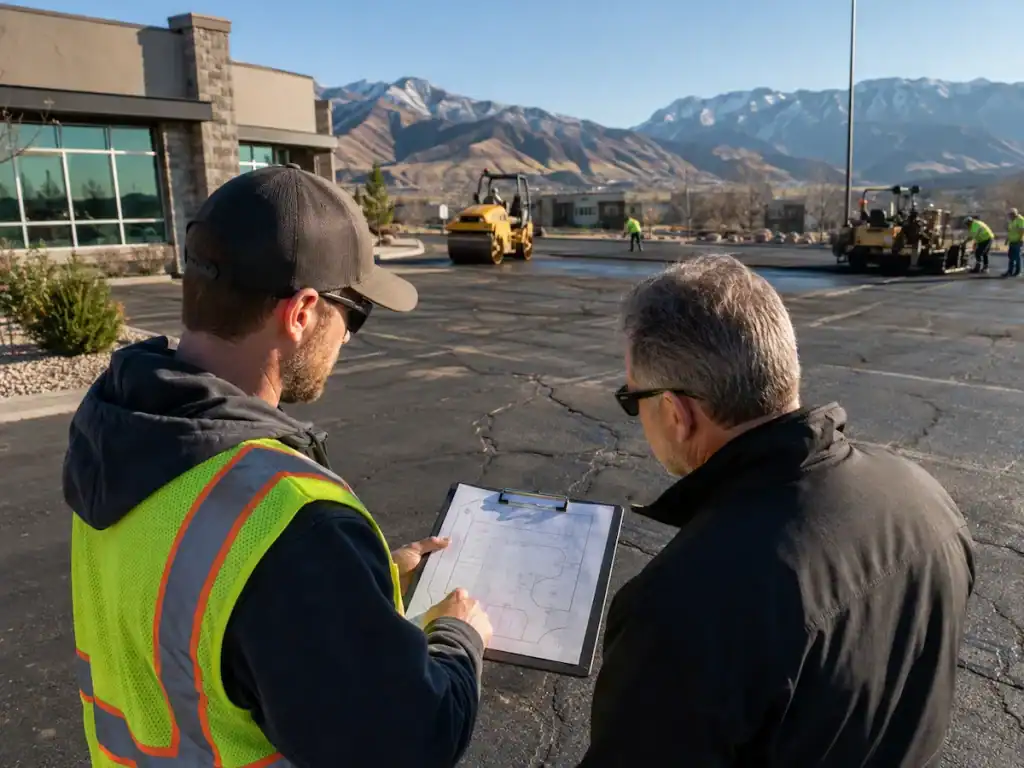
Reviewing the specifications of a Utah paving estimate.
Start by Confirming That Each Estimate Covers the Same Area
Before comparing materials or prices, verify the dimensions and total square footage included in each estimate. One contractor may have measured the entire property, while another may have excluded entrances, loading areas, approaches, shoulders, or sections that appear usable.
The proposal should identify the work area clearly enough that you know where the new pavement will begin and end. For a large parking lot or private road, a marked aerial image, site plan, or written description can reduce confusion.
Ask each Utah paving contractor to clarify:
- The estimated square footage
- Which pavement sections are included
- Whether approaches and transitions are included
- Which areas will remain untouched
- Whether the work will be completed at once or in phases
A proposal covering more square footage will naturally cost more. Comparing total prices without checking the measured areas can make the more complete estimate appear unnecessarily expensive.
Compare the Proposed Type of Paving Work
Different contractors may recommend different solutions for the same property. One estimate might call for complete removal and replacement, while another proposes an overlay or repairs only the most visibly damaged sections.
Common paving approaches include:
- New asphalt installation over a prepared aggregate base
- Full-depth removal and replacement
- Asphalt overlay over an existing surface
- Milling followed by an overlay
- Localized patching before resurfacing
- Repairing only selected failed areas
These approaches do not provide identical results or address the same problems. An overlay may be reasonable when the existing pavement and base remain structurally stable. It may not be appropriate when the property has widespread settlement, severe drainage problems, unstable soil, or extensive base failure.
If the recommendations differ significantly, ask each estimator to explain why the proposed method is appropriate. Existing pavement problems may also require an evaluation of available asphalt repair options before a final paving scope can be established.
Review Removal, Milling, and Disposal Details
When existing pavement must be removed, the estimate should explain how much material will be taken out and what will happen to it. Removal requires equipment, labor, hauling, and disposal or recycling, so it can represent a substantial portion of the project cost.
Look for details such as:
- The approximate removal depth
- Whether all pavement or only selected areas will be removed
- Whether unsuitable base material is included
- Hauling and disposal responsibilities
- Milling around curbs, gutters, drains, or connecting pavement
- Cleanup after demolition
Asphalt milling services may be used to remove a controlled depth of pavement or create proper transitions. Milling is different from complete excavation, so the estimate should make clear which method is being proposed.
Examine the Aggregate-Base Work
The base beneath the asphalt is one of the most important parts of the pavement system. It supports vehicle loads, provides a stable surface for paving, and influences how well the pavement resists cracking, rutting, and settlement.
Unfortunately, base preparation is also an area where estimates can differ substantially. One proposal may include several inches of new aggregate and extensive compaction, while another assumes the existing base can remain in place.
Ask the contractor to specify:
- Whether the existing base will be inspected or reconditioned
- The type and estimated depth of new aggregate
- Whether the base depth is measured before or after compaction
- How soft or unstable areas will be handled
- Whether moisture conditioning is included
- How the base will be graded and compacted
Some subsurface conditions cannot be confirmed until the old pavement is removed. The estimate should therefore explain how unforeseen soft spots or unsuitable material will be documented, priced, and approved.
Utah properties may contain expansive soil, clay, disturbed fill, trapped moisture, or inadequately compacted material. Our guide to soft spots beneath asphalt explains why these unstable areas should be corrected before paving.
Compare Compacted Asphalt Thickness
Asphalt thickness should be one of the clearest specifications in a Utah paving estimate. It affects material quantities, structural capacity, compaction, and price.
Make sure the proposal describes the finished compacted thickness rather than only the loose depth placed before rolling. Asphalt becomes thinner as rollers compress the material, so those measurements are not interchangeable.
The appropriate pavement design depends on:
- The intended use of the property
- Passenger-vehicle and heavy-truck traffic
- The condition and depth of the aggregate base
- Underlying soil conditions
- Drainage and environmental exposure
- Whether the asphalt will be placed in one or multiple lifts
A residential driveway and an industrial yard should not automatically receive the same design. Loading zones, dumpster routes, fire lanes, bus areas, and delivery entrances may require additional support because they experience heavier or more concentrated loads.
Review our guide explaining how thick asphalt should be for more information about pavement thickness and intended use.
Ask What Asphalt Mixture Will Be Used
An estimate should provide enough information to establish that the contractor is using an asphalt mixture appropriate for the project. Private and commercial projects do not always require the same specifications as public highways, but the mixture still needs to match the pavement design and expected traffic.
Ask whether the proposal identifies:
- The general asphalt mixture or specification
- The asphalt supplier or plant when relevant
- Whether one or multiple asphalt lifts will be installed
- How the mixture fits the intended vehicle loads
- Whether tack coat is included for an overlay or adjoining surface
Material quality matters, but it is only one part of the installation. Asphalt must also be delivered, placed, and compacted within an appropriate temperature range. Long hauling distances, cold weather, wind, restricted access, and small isolated areas can affect how quickly the material cools.
Determine How Grading and Drainage Are Addressed
Drainage can be one of the most important differences between Utah paving estimates. A proposal that addresses existing low spots, improper slopes, or failing transitions may cost more than one that simply follows the current surface.
Water that remains on the pavement can enter cracks, reach the base, and contribute to settlement or potholes. Utah freeze-thaw cycles can make the problem worse when trapped moisture freezes and expands.
The contractor should explain how the project will:
- Establish appropriate pavement slopes
- Direct runoff toward drains, gutters, or approved discharge areas
- Correct known areas of standing water
- Meet existing curbs, sidewalks, and concrete
- Adjust utility covers or drainage structures when necessary
- Avoid directing water toward buildings or neighboring properties
Eckles Paving provides professional grading services in Utah and can incorporate suitable parking lot drainage solutions when required by the site.
No contractor should promise perfect drainage without evaluating existing elevations and available discharge points. The proposal should instead identify the drainage work included and any limitations created by the surrounding property.
Review Edge Work, Joints, and Transitions
Edges and transitions can influence both appearance and long-term performance. New asphalt may need to connect with existing pavement, concrete aprons, sidewalks, garage floors, roadways, utility structures, or neighboring surfaces.
Ask how the contractor plans to handle:
- Connections to existing asphalt
- Transitions at curbs and gutters
- Garage, sidewalk, and concrete elevations
- Unsupported pavement edges
- Longitudinal and transverse joints
- Drain and utility-cover elevations
The estimate may include saw cutting, milling, excavation, handwork, tack coat, or additional compaction around these areas. If transitions are not mentioned, request clarification before approving the work.
Check Whether Patching and Crack Repairs Are Included
An overlay estimate may require repairs before the new surface is installed. Paving over potholes, severe cracks, settlement, or failed base areas does not eliminate the underlying cause of the damage.
The proposal should identify whether it includes:
- Removal and replacement of failed pavement
- Full-depth patching in unstable areas
- Repair of potholes before resurfacing
- Treatment of cracks or joints
- Additional charges for concealed failures
Localized asphalt patching and pothole repair may be necessary before an overlay. Cracks should also be evaluated to determine whether they are suitable for professional crack sealing or indicate a deeper structural problem.
Compare Striping and Finishing Services
Commercial Utah paving estimates may or may not include parking lot striping. If the proposals differ in price, check whether one contractor included pavement markings, traffic control, or layout work that another excluded.
Striping items may include:
- Parking stalls
- Accessible parking spaces and access aisles
- Directional arrows
- Fire lanes and loading zones
- Crosswalks and pedestrian areas
- Curb markings
- Numbering or stenciling
If the layout will change, the contractor should confirm the proposed design before painting begins. Professional parking lot striping in Utah can be included as part of a coordinated paving project or scheduled after the surface is ready.
Also determine whether the proposal includes cleanup, debris removal, final grading around the pavement, temporary barricades, and reopening instructions.
Understand Allowances, Unit Prices, and Possible Additional Costs
Some site conditions remain hidden until construction begins. Contractors may address this uncertainty through allowances, unit prices, exclusions, or written change-order procedures.
A detailed estimate should explain how additional work will be handled rather than leaving the property owner to discover the process after demolition.
Potential additional costs can include:
- Unexpected soft or saturated soil
- Additional aggregate-base material
- Buried concrete or abandoned structures
- Unmarked private utilities
- Drainage modifications
- Additional hauling and disposal
- Traffic-control changes
- Work requested after the original estimate
Ask whether extra work will be charged by the square foot, ton, truckload, cubic yard, labor hour, or another unit. You should also know who is authorized to approve changes and what documentation will be provided.
Evaluate the Project Schedule and Access Plan
Price is not the only consideration for an occupied commercial property, apartment community, school, church, HOA, or industrial facility. Project phasing and access can affect tenants, customers, deliveries, employees, residents, and emergency vehicles.
Compare the estimated:
- Construction start window
- Number of working days
- Daily working hours
- Property closures and traffic restrictions
- Time required before vehicles can return
- Phasing plan for occupied properties
- Procedures for weather delays
A proposal that includes careful phasing may cost more than one based on unrestricted access to the entire property. That additional coordination can be valuable when closing the whole site would disrupt business operations.
Utah weather also affects scheduling. Cold temperatures, precipitation, saturated ground, strong wind, and high-elevation conditions can influence paving and compaction. Read about the best time for asphalt installation in Utah when evaluating seasonal project dates.
Confirm Traffic Control and Property Preparation Responsibilities
The estimate should explain which party is responsible for preparing and controlling the property. These responsibilities may seem minor, but they can cause delays or additional charges when they are not discussed in advance.
Clarify who will:
- Move vehicles, dumpsters, trailers, and portable equipment
- Notify tenants, residents, employees, or customers
- Provide cones, barricades, and traffic-control personnel
- Coordinate deliveries and garbage collection
- Mark private utilities and irrigation components
- Provide access to locked gates
- Arrange temporary parking
- Protect the work area after the crew leaves
For projects beside public roads or busy entrances, traffic control may require additional planning. Make sure those services are included when they are necessary for safe access and construction.
Compare Contractor Qualifications and Insurance
A paving estimate should be evaluated alongside the contractor providing it. Before signing an agreement, confirm that the company is qualified to complete the size and type of project being proposed.
Important considerations include:
- Current contractor licensing
- Liability and workers’ compensation insurance
- Experience with similar properties
- Equipment and crew capabilities
- References or verified customer reviews
- A physical business presence and reliable contact information
- A written contract and change-order process
- Clear communication before work begins
Commercial parking lots, private roads, industrial yards, and phased projects require different resources than small isolated repairs. Ask whether the contractor has completed comparable work and can provide the equipment, staffing, traffic control, and project management needed for your property.
Read Warranty Terms Carefully
Warranty language can vary significantly between Utah paving contractors. A longer warranty is not automatically better if the coverage, exclusions, and claim process are unclear.
Review:
- The length of the warranty
- Which materials and workmanship are covered
- Excluded conditions or types of damage
- Property-owner maintenance requirements
- How warranty concerns must be reported
- Whether repairs or other remedies are specified
Common exclusions may involve fuel spills, utility work, ground movement, drainage from outside the work area, excessive vehicle loads, snowplow damage, or failures caused by underlying conditions that were not included in the project scope.
A warranty does not replace proper construction. A clear proposal describing the base, thickness, drainage, and installation is more useful than relying on vague promises about future performance.
Watch for Warning Signs in a Utah Paving Estimate
A professional estimate does not need to be unnecessarily complicated, but it should provide enough information to understand what you are purchasing.
Potential warning signs include:
- A price with little or no description of the work
- No square footage or defined project boundaries
- Asphalt thickness listed without stating whether it is compacted
- No explanation of base preparation
- Pressure to approve the work immediately
- A request for an unusually large cash payment
- No business address, license information, or proof of insurance
- Promises that ignore visible drainage or structural problems
- No written procedure for additional work
- A significantly lower price that cannot be explained
Price differences do not automatically mean that one contractor is cutting corners. Equipment availability, project size, hauling distance, material quantities, scheduling, and company operations can all affect pricing. The important question is whether the contractor can explain the estimate and support the proposed scope.
Create a Side-by-Side Paving Estimate Comparison
A simple comparison sheet can make differences easier to identify. List each contractor across the top and compare the same categories underneath.
Useful comparison categories include:
- Total square footage
- Removal or milling depth
- Aggregate-base work
- Compacted asphalt thickness
- Number of asphalt lifts
- Drainage and grading work
- Patching and soft-spot repairs
- Transitions and edge preparation
- Striping and finishing work
- Traffic control and phasing
- Cleanup and disposal
- Estimated schedule
- Payment terms
- Warranty coverage
- Potential additional charges
Mark any item that is unclear rather than assuming it is included. A short conversation with each contractor can often explain why prices differ and help you revise the proposals into a more accurate comparison.
Should You Automatically Choose the Lowest Paving Estimate?
No. The lowest estimate may be the right choice when it provides an appropriate scope from a qualified contractor. It should not be selected solely because of the final number.
A lower price may reflect less excavation, a thinner pavement design, limited base work, excluded striping, fewer drainage corrections, or a smaller measured area. It may also reflect legitimate efficiencies, such as convenient scheduling, nearby equipment, or favorable asphalt-plant access.
Instead of assuming that the highest or lowest bid is best, compare:
- Whether the proposed solution addresses the property’s problems
- The quantities and specifications included
- The contractor’s qualifications and relevant experience
- How uncertain conditions will be handled
- The clarity of the written agreement
- The total value and expected result
For general pricing information, review our Utah asphalt paving cost guide. A site-specific inspection is still necessary because pavement condition, access, base requirements, and drainage can cause substantial differences between properties.
Questions to Ask Before Accepting a Utah Paving Estimate
Before approving a proposal, ask the contractor to answer any questions that are not addressed clearly in writing.
- What exact area and square footage are included?
- Why are you recommending this paving method?
- Will the existing asphalt be removed, milled, repaired, or overlaid?
- What base preparation is included?
- How will soft spots or unsuitable soil be priced?
- What is the compacted asphalt thickness?
- How will drainage, edges, and transitions be handled?
- Are cleanup, disposal, traffic control, and striping included?
- How will the property remain accessible?
- What could cause the price to change?
- What are the payment terms?
- What does the warranty cover?
A dependable Utah paving contractor should be willing to explain the proposal in straightforward language. Important answers should be added to the written agreement when they affect price, materials, responsibilities, or the finished result.
Why Choose Eckles Paving?
Eckles Paving has more than 35 years of experience completing asphalt paving and pavement maintenance work throughout Utah. Our licensed and insured team serves commercial properties, HOAs, private roads, schools, churches, municipalities, retail centers, apartment communities, industrial facilities, warehouses, and residential properties.
Experienced crews and professional equipment allow Eckles Paving to complete new paving, removal and replacement, overlays, asphalt repair, milling, grading, drainage work, crack sealing, sealcoating, and parking lot striping. This range of services helps our team evaluate the complete pavement system instead of considering only the visible surface.
Eckles Paving has earned more than 1,300 five-star reviews and maintains a 5.0 Google rating. Customers choose our company for dependable communication, experienced crews, large-project capabilities, and comprehensive pavement services.
Learn more about Eckles Paving and our approach to serving Utah properties.
Utah Areas We Serve
Eckles Paving provides asphalt paving and pavement maintenance throughout our Utah service areas, including Utah County, Salt Lake County, Davis County, Weber County, Cache County, Summit County, Wasatch County, Tooele County, Morgan County, and Box Elder County.
Our crews serve properties around Mapleton, Salt Lake City, West Valley City, Park City, Heber, Ogden, Logan, and many surrounding communities. Project availability depends on location, size, scope, and scheduling requirements.
Frequently Asked Questions About Utah Paving Estimates
How many Utah paving estimates should I get?
Many property owners request two or three estimates so they can compare recommendations, specifications, pricing, and contractor qualifications. The estimates are most useful when each contractor evaluates the same work area and receives the same information about pavement use, traffic, drainage, and desired results.
Why are paving estimates sometimes so different?
Estimates can differ because contractors measured different areas or proposed different excavation depths, aggregate-base work, asphalt thicknesses, repairs, drainage improvements, or finishing services. Equipment mobilization, hauling distance, access, traffic control, and scheduling can also affect the price.
Should asphalt thickness be listed as compacted thickness?
Yes. Asking for compacted thickness creates a clearer comparison because asphalt becomes thinner as it is rolled. A loose placement depth and a finished compacted depth do not describe the same quantity of material.
What happens if the contractor finds soft soil after removing the asphalt?
The unstable material should be evaluated before paving continues. The estimate or contract should explain how unforeseen excavation, aggregate, stabilization, and compaction will be documented and approved. Unit prices can make these additional costs easier to understand.
Does a paving estimate usually include parking lot striping?
Not always. Some contractors include replacement striping in the paving proposal, while others price it separately. Confirm whether the estimate includes layout, accessible markings, fire lanes, arrows, crosswalks, curbs, and other required markings.
How long should a Utah paving estimate remain valid?
The validity period depends on the contractor and current material conditions. Asphalt, aggregate, fuel, hauling, and labor costs can change, so proposals commonly include an expiration date. Ask whether pricing can change after approval because of scheduling delays or material adjustments.
How much does Utah paving cost?
Utah paving costs depend on total square footage, demolition, base preparation, asphalt thickness, drainage, access, hauling distance, traffic control, and the intended use of the pavement. Larger projects may have a lower cost per square foot because mobilization expenses are distributed across more area. An on-site evaluation provides the most reliable price.
Request a Free Utah Paving Estimate
A useful paving estimate should explain what will be removed, how the base will be prepared, what asphalt will be installed, and how drainage, transitions, and finishing work will be handled. Comparing those details helps property owners make a better decision than comparing total prices alone.
Eckles Paving provides Utah paving services for commercial parking lots, private roads, HOA communities, schools, churches, retail properties, industrial facilities, apartment communities, and residential driveways.
If you are planning a new pavement installation, overlay, replacement, or other asphalt project, request a free paving estimate from Eckles Paving. Our team will inspect the property, explain the recommended scope, and provide a proposal based on your site’s actual requirements.
Industry Resources
- Asphalt Institute — Information about asphalt materials, pavement design, construction, and maintenance.
- Federal Highway Administration Pavement Program — Educational resources concerning pavement materials, construction, preservation, and performance.
- Utah Department of Transportation Materials and Pavements — Utah-specific resources covering pavement materials, testing, and quality standards.