A running track depends on more than the condition of its visible surface. The asphalt and base underneath must provide a smooth, stable foundation capable of supporting years of use and exposure to Utah’s changing weather.
In July 2026, Eckles Paving completed a full asphalt replacement project around the track at Carbon High School in Price, Utah. The work included removing four inches of existing asphalt, finish grading the track, reconstructing a weakened section of the base, and installing four inches of new asphalt in two compacted layers.
This large-scale school project created a stronger, more uniform asphalt foundation around the entire track.
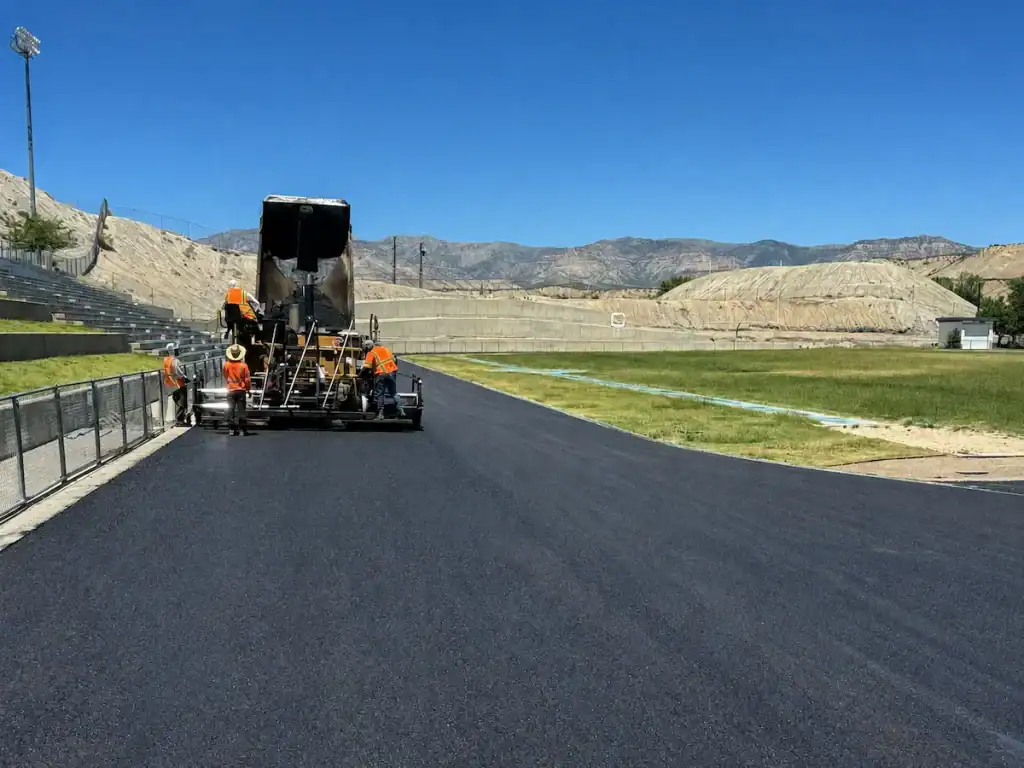
New asphalt being installed around the Carbon High School track.
Carbon High School Track Replacement Project
The project encompassed the full track at Carbon High School. Rather than completing isolated patches or placing a thin surface treatment over the existing pavement, the project called for complete asphalt removal and replacement.
The primary scope of work included:
- Removing four inches of existing asphalt around the entire track
- Finish grading the prepared surface
- Reconstructing a weakened section of the underlying base
- Installing and compacting a 2.5-inch asphalt layer
- Applying a tack coat between asphalt layers
- Installing a 1.5-inch asphalt surface layer
- Creating a total asphalt thickness of four inches
Completing these steps across the entire track required careful grading, material placement, equipment coordination, and compaction.
Removing Four Inches of Existing Asphalt
The first major step was removing the existing asphalt around the track. Full-depth removal made it possible for the crew to inspect the underlying surface and prepare a consistent foundation for the replacement pavement.
Simply paving over deteriorated asphalt can leave existing problems underneath the new surface. Cracks, uneven areas, and unstable material may eventually affect the pavement placed above them. Removing the existing four-inch asphalt section allowed the track to be rebuilt from a properly prepared surface.
The old asphalt also had to be removed carefully around the curved track layout. Consistent removal depths were important because irregularities in the prepared surface could affect the thickness and smoothness of the new asphalt.
Learn more about our asphalt milling and pavement removal services in Utah.
Preparing and Finish Grading the Track
After the existing asphalt was removed, the exposed surface was finish graded. Proper grading helps create the correct elevations and a uniform platform for new asphalt.
Grading was especially important on this project because the track included long straightaways, curved sections, and transitions connecting different areas. The prepared surface needed to remain consistent throughout the entire layout.
Finish grading helps:
- Create a smooth foundation for new asphalt
- Maintain consistent pavement thickness
- Correct irregularities in the prepared surface
- Support proper surface drainage
- Improve the quality of the finished pavement
A well-prepared foundation is one of the most important parts of an asphalt replacement project. Even high-quality asphalt can develop problems when it is placed over an uneven or unstable base.
Learn more about professional grading services in Utah.

Crews prepare and finish grade the track.
Reconstructing a Weakened Base Section
One section of the track required more extensive reconstruction beneath the asphalt. In this area, approximately 18 inches of existing base material was removed and hauled away.
The deeper reconstruction included:
- Removing 18 inches of existing base material
- Installing separation geotextile fabric
- Placing 12 inches of structural fill
- Installing stabilization geogrid
- Placing and compacting six inches of road base
This process rebuilt the supporting structure before new asphalt was installed above it.
Addressing the base was important because asphalt depends on the strength of the material beneath it. When the base is weak, wet, or unstable, the pavement may settle, crack, or develop soft areas—even if the asphalt itself was installed correctly.
Instead of covering the problem, the affected section was excavated and rebuilt with multiple layers designed to improve separation, stability, and load distribution.
Visit our resource explaining what causes soft spots in asphalt and how they are repaired.
How Geotextile Fabric and Geogrid Support Asphalt
The reconstructed section included both separation geotextile fabric and stabilization geogrid. Although these materials serve different purposes, they work together to improve the pavement foundation.
Separation fabric helps prevent the newly placed structural material from mixing with the soil below it. Keeping these layers separated helps preserve the integrity of the reconstructed base.
Geogrid provides additional stabilization by helping distribute forces across the base. It reinforces the aggregate layer and can reduce movement in areas where the underlying ground requires additional support.
Once these materials were installed, the crew placed the specified structural fill and compacted road base. This created a more stable platform for the new asphalt.
Installing the First Asphalt Layer
After grading and base preparation were complete, Eckles Paving installed the first asphalt layer around the track. This lower course was placed and compacted to a thickness of approximately 2.5 inches.
The first lift provided the primary asphalt structure for the track. Careful placement and compaction were necessary to create a dense, even surface before the final layer was installed.
Compaction reduces air spaces within the asphalt mixture and helps the aggregate and asphalt binder form a strong pavement layer. The crew had to maintain consistent compaction around both the straight and curved portions of the track.

The Eckles Paving crew installs asphalt around the track.
Applying Tack Coat Between Asphalt Layers
Before the surface layer was installed, the first asphalt lift was cleaned and a tack coat was applied. Tack coat is a bonding material placed between asphalt layers.
This bonding step helps the two asphalt courses act as one pavement structure. Without a proper bond, layers can move independently and become more vulnerable to slipping, separation, or premature deterioration.
Cleaning the lower lift before applying tack coat was also important. Dust and loose debris can interfere with bonding, so the surface needed to be properly prepared before the final asphalt course was placed.
Installing the Final Asphalt Surface
The final phase of paving included placing and compacting a 1.5-inch asphalt surface layer. Combined with the 2.5-inch lower course, the completed pavement had a total asphalt thickness of four inches.
Using two asphalt lifts provided an opportunity to establish the structural layer first and then create a smoother, more uniform finished surface.
During placement, the paving crew monitored:
- Asphalt thickness
- Surface smoothness
- Material temperature
- Compaction
- Connections between paving passes
- Transitions along curves and straight sections
These details were particularly important on a track, where inconsistencies are more noticeable than they may be on an ordinary parking area.
Learn more about commercial asphalt paving in Utah.
Paving the Curves and Straightaways
A high school track presents a different paving layout than a rectangular parking lot or straight roadway. The curved ends require careful equipment movement and close attention to the edge of each paving pass.
The crew also needed to create consistent transitions between the curves and straightaways. Variations in width, elevation, or asphalt placement could affect the uniformity of the finished track foundation.
Experienced equipment operators and ground crews worked together to guide the paving operation around the complete oval. This coordination helped maintain consistent asphalt coverage across the entire project.
Why Full Asphalt Replacement Was the Right Approach
Asphalt maintenance services such as crack sealing and sealcoating can extend the life of pavement that remains structurally sound. However, those treatments cannot correct widespread structural deterioration or problems beneath the asphalt.
Complete replacement is generally considered when:
- Deterioration affects a large portion of the pavement
- The existing asphalt can no longer provide a reliable foundation
- Repeated repairs are no longer practical
- Surface irregularities require more extensive correction
- Sections of the underlying base need reconstruction
At Carbon High School, removing and replacing the full asphalt section allowed the track foundation to be rebuilt comprehensively rather than relying on temporary surface repairs.
For additional information, visit our Utah asphalt repair services page.

The Eckles Paving crew installs new asphalt around the track.
Completing Asphalt Work During Summer Break
July provided a practical time to complete the Carbon High School project. Scheduling major pavement work during summer can reduce conflicts with regular school traffic, student activities, buses, and daily campus operations.
Summer conditions can also provide a favorable paving window in Price, although every project still depends on daily temperatures, precipitation, wind, material conditions, and the construction schedule.
Completing the asphalt replacement before the next school year helped prepare the track area for future campus and athletic use.
Building Asphalt for Price, Utah Conditions
Asphalt in Price and Carbon County experiences hot summer sunlight, cold winter temperatures, snow, moisture, and repeated freeze-thaw cycles. These seasonal changes can place stress on both the pavement and its underlying base.
Water that reaches weak areas beneath asphalt can contribute to movement and deterioration. When temperatures fall below freezing, trapped moisture can expand and place additional pressure on the pavement structure.
That is why proper grading, base preparation, asphalt thickness, bonding, and compaction were all essential parts of the Carbon High School track replacement.
The Completed Carbon High School Track
Once paving was complete, the full track had a new, consistent asphalt foundation. Four inches of asphalt were installed in two compacted layers, while the identified weak section received comprehensive base reconstruction before paving.
The completed project reflects the importance of addressing every layer of a pavement system. Removing the old asphalt, correcting the base, finish grading, applying tack coat, and carefully placing the new asphalt all contributed to the final result.

The completed Carbon High School track.
Why Choose Eckles Paving for School Asphalt Projects?
School pavement projects require an asphalt contractor capable of coordinating work around campus facilities, summer schedules, athletic areas, and other site-specific conditions.
Eckles Paving has more than 35 years of experience completing asphalt projects throughout Utah. Our crews work on schools, commercial parking lots, private roads, HOAs, industrial properties, municipal sites, and other large pavement areas.
Our services include:
- Asphalt paving and replacement
- Asphalt repair and patching
- Milling and pavement removal
- Grading and base preparation
- Crack sealing and sealcoating
- Parking lot and pavement striping
- Drainage improvements
Eckles Paving is licensed and insured and has earned more than 1,300 five-star reviews with a 5.0 Google rating.
Asphalt Paving in Price and Eastern Utah
Eckles Paving provides commercial and institutional asphalt services in Price, Carbon County, and communities throughout Utah. Our team has the crews, equipment, and experience needed for projects ranging from localized pavement repairs to complete asphalt replacement.
Visit our Utah asphalt service areas page to learn more about where we work.
Frequently Asked Questions
What work did Eckles Paving complete at Carbon High School?
Eckles Paving removed and replaced the asphalt around the entire high school track. The project included four inches of asphalt removal, finish grading, base reconstruction in a weakened area, and four inches of new asphalt installed in two layers.
When was the Carbon High School track project completed?
The asphalt replacement project was completed in July 2026 in Price, Utah.
How thick was the new asphalt?
The completed pavement included a 2.5-inch lower asphalt course and a 1.5-inch surface course, creating a total asphalt thickness of four inches.
Why was the asphalt installed in two layers?
Installing two compacted asphalt lifts helped create a strong pavement structure and a smooth, uniform finished surface. Tack coat was applied between the layers to promote bonding.
What was done in the weakened base area?
Approximately 18 inches of existing base material was removed. The section was rebuilt using separation fabric, structural fill, stabilization geogrid, and compacted road base before the new asphalt was installed.
Why is base preparation important for asphalt?
The base supports the asphalt above it. An unstable or poorly prepared base can contribute to settling, cracking, soft spots, and premature pavement failure.
Does Eckles Paving complete asphalt projects for other schools?
Yes. Eckles Paving provides asphalt paving, repair, maintenance, and striping services for schools and other institutional properties throughout Utah.
Request a Free Asphalt Estimate
If your school, commercial property, athletic facility, private road, or parking lot needs asphalt replacement, Eckles Paving can inspect the pavement and recommend an appropriate solution.
Request a free estimate from Eckles Paving for asphalt paving or replacement in Price or elsewhere in Utah.

The Eckles Paving crew installs new asphalt around the track.